A ronin walks alone — no master, no fixed path. Just skill, discipline, and the road ahead.
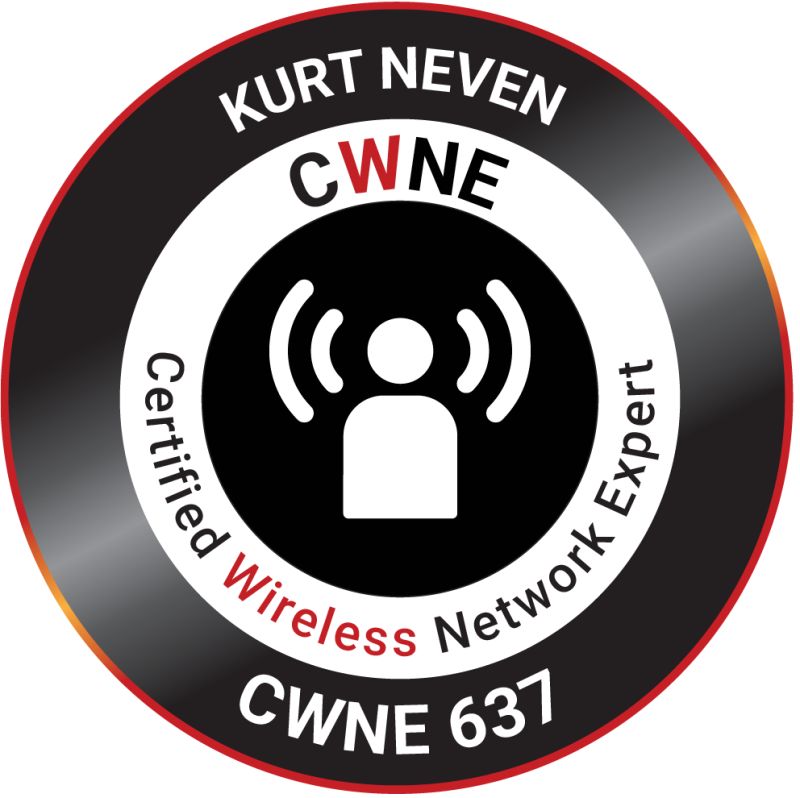
That line has been sitting at the top of this blog since the day I started it. Back then it was aspirational. Today I get to write it as a fact: I am CWNE #637.
Where this actually started
If you’ve read my “About” page, you know Wi-Fi was never the plan. I graduated in 2006 with a master’s degree in trumpet and spent a few years actually living the professional musician life. It was romantic in parts. It also didn’t pay the bills the way I needed it to, so I did something a little insane: three years of evening classes, a full networking course, while working during the day.
That decision eventually put a heat map in my hands instead of a baton. I ended up as a Solutions Architect and Wireless Architect at Quant ICT, and somewhere in there decided the CWNE was going to be the destination. This blog was always meant to be the journey in between — and now I get to write the chapter where the journey reaches CWNE #637.
From CWNA to CWNE: the mountain range
People who haven’t walked the CWNP path sometimes assume it’s “just five exams.” It’s not. It’s five certifications, each one forcing a different kind of thinking:
The foundation. RF behavior, 802.11 basics, the vocabulary you’ll use for everything after.
Design. Turning requirements into a network that actually survives contact with a building.
Analysis. And for me, without question, the biggest mountain on the whole range.
Security. Key hierarchies, the 4-way handshake, WIPS, fast roaming — the stuff that looks simple until you have to explain why it works.
IoT. The one that closed out my prerequisites.
CWAP deserves its own paragraph, because it earned it. Packet analysis is a different mindset than design or security. You’re not building or defending anything, you’re interrogating evidence. It forces you to slow down and read what’s actually in the capture, not what you expect to find there.
By the time I passed CWISA-103, I’d been at this for months, on top of a full-time job, a wedding photography business, an orchestra I conduct, and a big band I still play trumpet in. The prerequisites weren’t a checklist to tick off. They were months of evenings and weekends, one exam at a time.
Then came the application
Passing five exams doesn’t get you a CWNE. It gets you eligible to apply. The CWNE application asks you to prove you haven’t just passed tests, you’ve actually done the job.
CWNE candidates have to submit case study essays that prove real-world wireless engineering, not textbook knowledge. I wrote three, each built around a project I’d actually lived through.
This one started as a mystery and ended as a lesson in how a single, easily-overlooked information element can take down mission-critical voice traffic in an environment where “the Wi-Fi is a little slow” isn’t an acceptable failure mode.
A warehouse where the business had gone Wi-Fi-first, but one device wasn’t playing by the rules. And a reminder that changing the physical layout of a building without rethinking the wireless design can cause real problems.
Three essays, three very different failure modes, one common theme:
‘The network always tells you what’s wrong, if you’re willing to listen closely enough’