The Final Prerequisite: Passing the CWISA exam
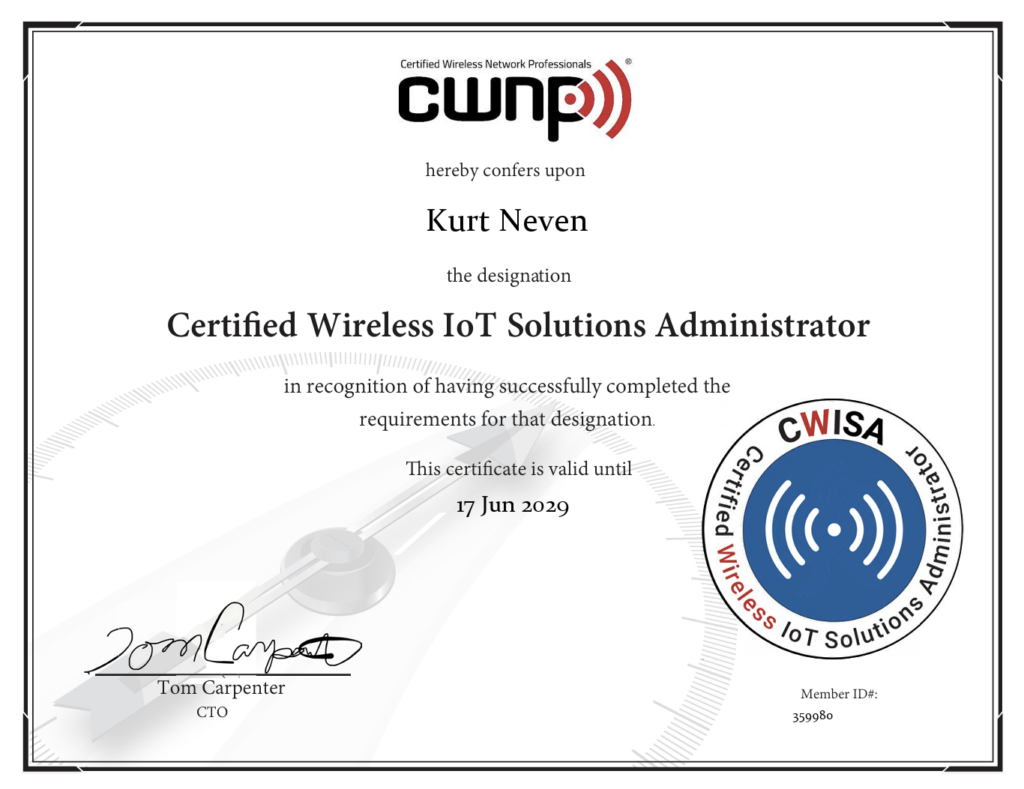
There is a particular satisfaction in ticking the last box — even when the door ahead still has a few more locks to pick. Passing the CWISA-103 — the Certified Wireless IoT Solutions Administrator exam — was exactly that moment. With this certification now in place, I have completed every prerequisite exam for the CWNE application.
So, what is the CWISA all about?
The CWISA is the entry-level certification in CWNP’s IoT track. Think of it as the CWNA’s IoT cousin — broad by design, covering a lot of ground rather than deep-diving into any single technology. It touches on RF essentials, IoT fundamentals, device types, and wireless IoT solutions administration.
For the CWNE path, it is the fifth and final required exam alongside CWNA, CWSP, CWAP, and CWDP.
The exam spans five main domains:
Wireless Technologies |
A survey of the IoT landscape: protocols, frequencies, standards organisations (IEEE, IETF, Wi-Fi Alliance), and the hardware and software components of IoT devices. Processors, memory, radios, sensors, operating systems. The full stack, from silicon upward. |
RF Communications |
The fundamental principles of RF. For anyone who has already sat CWNA or CWAP, a significant portion of this domain feels like familiar territory. |
IoT Device Types & Protocols |
This is where the content gets genuinely new for a Wi-Fi specialist. WPAN technologies, 802.15.4, Zigbee, Z-Wave, Bluetooth Low Energy, LoRaWAN, NB-IoT. |
Supporting Wireless Solutions |
Administration and troubleshooting across vertical markets: healthcare, industrial, smart cities, retail. Application architectures, data structures, APIs, scripting basics. |
IoT Security |
Enterprise IoT security controls, encryption in transit and at rest, secure boot, end-to-end security with specific attention to the constraints of resource-limited devices. |
Familiar Ground and New Territory
Coming from a Wi-Fi background, RF fundamentals were well-covered soil. Technologies like Zigbee and Bluetooth were not new either — they show up regularly in real-world deployments alongside WLANs. LoRaWAN, however, was a different story.
Heard of it, yes. Actually understood it? Not until this study cycle. Long-range, low-power, sub-GHz, chirp spread spectrum modulation — genuinely interesting technology, and a good reminder that the wireless world extends well beyond the 2.4, 5 and 6 GHz bands most of us spend our days in. |
How I Studied
No live training this time. The CWISA was entirely self-directed: the official CWNP study guide, the e-learning video modules, the official practice exams, and one additional tool — AI-generated mock questions. Working through the study guide chapter by chapter, I used Claude to generate targeted test questions based on the material, surfacing knowledge gaps that a simple re-read would have missed. It is a surprisingly effective way to stress-test your understanding, particularly for domains where you are less confident.
What’s Next
The CWNE application — and stickers, hopefully. 😊
Those who follow me know that I like my stickers, and that the CWISA one is painfully missing from my collection. So the plan: pick up both the CWISA and CWNE sticker at the same time. Efficient. Optimistic. Maybe a little delusional? — but let’s go with optimistic.
The application goes in over the coming days. Essays written, certifications in order, endorsements a work in progress. And then the hardest part… the waiting game. The CWNE Board of Advisors will do their thing, and all I can do is hope the work speaks for itself.
The door is open. The locks still need picking. But the key ring is finally complete. |